NECC’s police chief has eye on future as college seeks to improve, adapt security

Safety, one of the most important traits that the modern human deserves, has become an increasing concern in educational facilities across America. The rise in school shootings, attacks on college campuses, among other things has caused numerous educational facilities across the U.S to start implementing better security and in higher education implementing a police force in response to this issue.

Northern Essex Community College has started an initiative to create a police force and Deborah Crafts, the college’s Chief of Police and Director of Public Safety has been at the helm of this initiative.

In this initiative one of the biggest factors was the technology and improving it on campus. Chief Deborah Crafts has been a pivotal figure in these changes.

“When Northern Essex went from security to wanting to get into the 21st century they were looking for someone with a variety of campus experiences,” said Crafts. She has had a variety of campus experiences and this was important for the success of the initiative.

“Campus law enforcement is all about the community but a lot of it is about the technology,” she said.

These new technologies will be crucial in improving the structure of the campus, one of these technologies is an improved security monitoring system. “Since I started there’s at least 20 new cameras. And each camera does not have one view, so some of them might have two views, some of them might have 5 views, so we’ve got 50 more views,” she said.

The hope in improving the security visibility throughout campus is that incidents like theft, trespassing, damages, and attacks will be prevented, and hopefully through this they can improve safety.

Chief Crafts highlighted the importance of safety on campus but also noted on the pandemic and how the campus has had to respond to COVID-19.

“….I had the emergency planning background so I was able to convene a group of emergency planners,” she said.

Chief Crafts was able to draft a concrete plan with her team to help adjust the college’s policies to fit the COVID-19 guidelines. Her response to the pandemic is a reflection on her ability to successfully run the police force on campus. She is quick thinking and values transparency, something that was noted heavily on by her in a recent interview and you can see this in how the college handles COVID-19. When a case is reported the community knows quickly, there are so many resources available to one to deal with the current pandemic. Chief Crafts understands how difficult the current situation is currently, and her current goal in integrating new technologies into the campus shows that while she can handle today, she can make the future better.

Social media leads to an acceptance dilemma

Social media has become an enormously powerful tool that society has used for many different purposes. From Facebook to Instagram to many others we now have more ways to connect with people and to share information than ever before.

However, with great technological advances there comes a problem that needs to be addressed and that is how we are accepted in society. As more people are joining this ever-evolving movement, there appears to be a disconnect with how people are presenting themselves to the world.

“I think a lot of people get popular from social media and it depends on the person,” said NECC student Nisaly Gonzalez. There are many people in the world who use social media to help launch their careers by becoming influencers but as people are doing so, they become less likely to act like themselves in the process.

There is also an important factor that needs to be considered and that is the one that we call age. There are very stark differences of how kids and adults’ access social media.

“I think kids go on social media just for fun and entertainment, while adults go for work purposes,” Gonzalez said. There is also a maturity factor that plays in there as well.

“Adults are more mature than kids,” NECC student Nicholas Dalton said.

This has led many people to struggle with being accepted in today`s age of technology and really brought this idea of social media culture to the forefront.

“The advice I’d give someone struggling with changing themselves cause of a social media trend is I`d ask them  why they’d want to change themselves so much for something so small that’s not going to matter later. Wanting to look like someone else just because you can isn’t a great way to view yourself when you are already good as you are. Don’t copy someone else who is doing something that doesn`t work for you,” NECC student Khory Smith McPherson said.

There are many ways to combat this increasing problem.

“Taking it down and stop using it for a while,” Dalton said.

“Just being yourself is what matters most, following a trend isn`t bad just you don`t have to change something that is already working fine,” Smith McPherson said.


Social media in the time of COVID-19: How the pandmic has changed the way we use social media in 2020

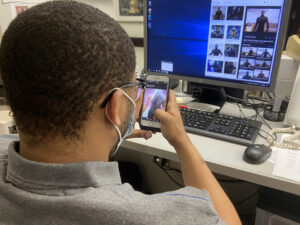
Ashmad Conde takes a break from work to check out his social media.
Ashmad Conde takes a break from work to check out his social media. Photo by Isae Grullon


Social media has been part of our daily lives since the early 2000s. In 2020, the COVID-19 pandemic changed the way many of us use it.  

Gyani Pradhan Wong Ah Sui, 18, of West Newbury, is in the NECC Exploratory program. He uses Snapchat, Instagram, and WhatsApp.  
Prior to the current pandemic he used social media “more sparsely,” he says. He would use Instagram for keeping up with friends as well as following various art related accounts.  
Sui started using Snapchat after moving to the United States. “Snapchat is not that popular in India, where I lived before I came here,” he says.  
He uses WhatsApp to keep in contact with his friends and family outside of the U.S. 
Sui says his social media use has “increased, because there’s not a lot of other things to do.” 
During the pandemic, Sui, an “aspiring filmmaker,” discovered a social media app called Letterboxd 
Letterboxd is social media for people who really like movies,” he says via Zoom. Using Letterboxd, you can post reviews, ratings and lists of movies you’ve watched and share them with friends. He uses the app to explore and see “different types of movies that I wouldn’t see otherwise.” 
He credits the pandemic for his discovery of Letterboxd and calls it “a plus.”  
Sui says his main purpose for using social media is “passing the time, although I try not to.”  
He also uses social media to communicate “especially during COVID, to connect with friends…” 
Occasionally he will use social media for news.  
“Sometimes I get my information through memes before the actual news article comes out,” he said with a chuckle.  
Sui does not think that social media has “been a solely negative thing,” and added, “Letterboxd, for sure, is like the silver lining. It’s just really fun to explore the artform that is film by finding out what other people think about the movies that they’re watching and helped me understand my own taste better, so I’m more reflective about what I like and don’t like in a film.” 
The one negative thing that Sui find about social media is “the whole ‘life looks better on social media,’ which can be disheartening and difficult to deal with. It’s a big time suck, at times.” 
Journalism and communications major, Mirrorajah Metcalfe, 19, of Haverhill, is aware of a decline in her social media activity.  Before the pandemic she used social media “just for stalking Halle Berry,” she says with a giggle via Zoom.  
She admits to not posting much at all other than “random posts to show you’re alive.”  
Metcalfe does not find social media to be helpful during the pandemic as she uses it mainly for entertainment purposes rather than for news or communication.  
She feels social media has a mostly negative impact on a lot people because everybody can kind of just see other people living their best lives and doing fun things while the rest of the world kind of has to stay in their rooms and be confined to a certain area and it’s hard not to compare yourself with other people and ‘think what can be,’ so I don’t know how healthy social media has been for everyone.”  
Metcalfe uses social media primarily on her cell phone which she calls “a stress box” and admits to purposefully not carrying it around all day unless she absolutely has to. She encourages anyone that feels they use social media too much to “take a break for an hour at least once and day and just be in the moment and spend time with yourself or your family.”
Ashmad Conde, 28, from Malden is a Unit Coordinator at Massachusetts General Hospital. Conde has used social media since 2005 when he created a Myspace account where he is no longer active.  His current social media use consists of Facebook and Snapchat. 
 Before the pandemic, he would check his social media as soon as he woke up. Over the last 10 months he has decided to decrease his social media use.  
“Not using is helpful,” says Conde about limiting his social media use. He has dedicated more time to reading and working out and feels more focused overall.  
He will eventually go back to using social media more than he is now, “this is just a pause…an experiment. he says, “I will go back to using it, but not at the same rate.”  
A familiar cell phone screen shot.
Photo by Isae Grullon