All posts by Observer Staff

Red Dead Redemption 2: A flawed masterpiece

Red Dead Redemption 2 was a video game developed by Rockstar games. It was released in 2019 and it is the prequal to the first game. The game has a breathtaking story mode with scenic landscapes, a great story with interesting characters and engaging gameplay mechanics which allows you to consistently come back to it.

The reason the story mode is so great is the world building. The way they introduce you to the world works so well. The game is about Arthur Morgan and the gang he runs with; the game is set during the end of the wild west era so the gang is desperate for money and are following their flawed leader Dutch Vanderlin. At the beginning of the game, you start out at this cabin on a snowy mountain, but as the game goes on it slowly and naturally leads you towards new areas because of the story. The world building gives you a real sense of natural progression in the game. Another plus about the game is the mechanics, they give you a large open world to play in, in the open world you can find random people who will lead you on side quests. You can also choose some dialogue options when approaching NPC’S, options such as rob, intimidate, greetings, and the best part about these options is that they will lead to different outcomes with different NPCs.  Finally, I also really like the overall story, as said before the game is set in the end of the wild west and outlaw era. You really get to see and feel how desperate Arthur and the rest of the gang becomes towards the end, when they realize that their leader Dutch actually has no plan on how to lead them to prosperity. Even though the gang is desperate to survive you get some more heartwarming moments when the gang feels less like a gang and more like a family

When asked on his opinion student Zachary cutter gave the following response “I played it and I loved it probably one of my favorite games that was put out by Rockstar games besides L.A. Noire. The game features events from the post-civil war era in America which I am an enthusiast with. The rise of woman’s rights that happened around the same time in our timeline. This era also saw the rise of the lost Cause myth which I loathe since it is a Conspiracist claim that the Civil war was over states’ rights which it was not and tried to glamorize the confederate cause case the neo confederate gang in the game you encounter the Lemoyne raiders and you can visit a slave holding house and a battlefield in the game. The game also features an early version of the KKK which you can shoot them to gain karma although in our timeline they were not a thing yet but still an ever-looming presence is still there. It also has 2 UFOs in the game and Serbian inventor Nikola Tesla although in the game he is called Marko Dragic. The game itself has the most beloved outlaw turned hero with Arthur Morgan. The van der Linde gang was a family we can relate to an extent and see how their fall began and see how Dutch end up in the shape we see him during the events of Red Dead Redemption 1. suffice to say this game is awesome in the history department.”

I think Red Dead Redemption 2 is one of the greatest games of all time. It has a large world packed to the brim with a ton of activities. The story is well thought out and very cinematic on its own. The game play mechanics allow for a large variety of user experience.  this game is a shining example of what open world games should be and I really hope Rockstar games stays on this track when it comes to making future games.

A year in a pandemic: How it has affected those with chronic illness.

It has been year since the World Health Organization declared SARS-CoV-2/COVID-19/The Coronavirus, a global pandemic. Since then, more than 118 million people have been infected worldwide, and 2.7 million have died. One of the groups of people that have been disproportionately affected by the pandemic, whether because of a COVID-19 diagnosis, or because of the restrictions put in place, are those who are chronically ill/disabled. Whether it is because of telehealth shortcomings, pain/quality of life treatments being delayed, or the very real fear of catching COVID-19, people in need of regular “maintenance” health care to manage their conditions feel discarded.

Mira Krishnaswamy, a 20-year-old with a chronic illness, said about the pandemic, “I was diagnosed before the pandemic started, so it was really difficult for me, at age of 19, having to go to the cancer center by myself and having to go through every single medical step with nobody by my side to support me, as the pandemic made it so nobody could go into the hospital with you. It was also really isolating because it broke my heart to see so many of the people I used to call “friends” not listening to the CDC and going out and partying. Because I am chronically ill, I am immunocompromised which meant that this pandemic literally threatened my life every single day. I could not leave my house for fear of my life. Seeing “friends” partying or not caring about the pandemic felt like a knife to the back because their actions can directly kill me. It essentially meant that they did not really care if I lived or died.” Krishnaswamy also spoke about how the “stay-at-home” order affected her mental and physical health, “Because of the pandemic all medical services were shut down for a while. This was horrible because I was doing upwards of 10 medical appointments a week. This was hard on my body mentally and physically because I was unable to get the medical care I needed for my chronic diseases for months at a time. I was literally bed ridden. I have ended most of my friendships with people that did not take the pandemic seriously because it was clear to me that they did not care about anyone other than themselves and did not care for my health or the health of others who cannot control their bodies. I also had to move mid-pandemic because I had spent the first half of the pandemic stuck in the house with an abusive step- parent. I do not think people understand how horrible it is to be stuck self-quarantined with an abuser.”

Mackenzie Lea, a 23-year-old from Alberta, Canada spoke about being chronically ill, and dealing with the randomness  of Trigeminal Neuralgia pain before and during the pandemic, “I am no stranger to isolation and unpredictability. Being chronically ill, my life has been upended a number of times. I have spent the last 7 years of my life locked away indoors, avoiding some of life’s greatest offers, as they stand a chance of causing me excruciating pain. I have missed out on work, school, time with friends and family, and events that I have really looked forward to. The terrifying truth is, I never know when I am going to be in pain. There are days where I can handle multiple tasks and there are days where I am completely bed bound. There is never a guarantee of being able to do things that I have been planning to do for months. When I try a new treatment, there is no guarantee that it will work or that it will not cause me to have debilitating side effects. That kind of isolation and unpredictability is devastating, and it takes an enormous toll on your mental health. When COVID-19 hit, I was undoubtedly fearful, but I also felt prepared. Lockdown is like how I have been living for years and as an optimistic person, I was actually hoping that this would foster empathy for the disabled experience. I was excited to give people tips on how to navigate isolation and unpredictability. For the first few months, life did not feel all that different. I was going out less than I usually did, but I felt more connected. With everyone locked down and programs like Zoom coming into popularity, the ability to connect became easier for me. I was talking to friends and family more than I had in years. Delivery services became more efficient, and many stores adopted hours where vulnerable people could safely come and shop. Workplaces and online school accommodations came about, and the world felt more accessible and approachable. However, as happy as I felt about all of this, it was also a bit angering. I am not the type of person that is going to complain about these immense strides, but disabled people have been asking for these accessible options for years. I left school and work because they could not accommodate me and it’s frustrating to realize that it was actually quite a simple fix and just a lack of effort.”

Mackenzie also talked about how her treatments have been affected by COVID-19, “As time has gone on, I have definitely started experiencing a decline in my mental health. People in my area are constantly protesting lockdowns and masks, our government is acting very slowly, and our numbers continually skyrocket. I do not feel safe anymore. I have heard so many people say things like, “if you’re scared or at risk, just stay home”, but that is not an option for me. I have to leave my house to go to medical appointments; I cannot get infusions at home and I have a port in my chest that requires maintenance. My specialist has temporarily switched to a Covid unit, so my care has been transferred to stand-in doctors and nurses that are not familiar with my rare disease. Delivery fees have become more expensive and being someone that is on a limited Disability budget, I cannot always afford to get things delivered. I have had to alter my already strict budget to include things like masks, gloves, and cleaning products, so I have no room for tips and extra fees. My pharmacy is running so low on one of my medications that I had to temporarily switch to something else. Not only did I have a reaction to the new medication, but it is also more expensive. I feel like I am simply surviving instead of living sometimes.”

While people living with chronic illness and disabilities are at a higher risk of contracting COVID-19, we also know from their stories that the pandemic has affected their mental health and their quality of care. For more information about chronic illnesses, and the COVID-19 pandemic, go to https://www.cdc.gov/ and/or https://www.hhs.gov/.

A police department’s role within local government

When you think of the functions and inner workings of a local government, you may not think of how the police department might be involved within that system.

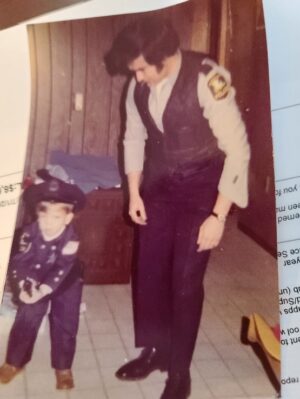
To discuss exactly how the police operate, Deputy Chief of Police in Amesbury Craig Bailey, speaks about how a police department functions to keep people safe within their communities. At the Amesbury Police Department Deputy Chief Bailey works to instill discipline and training, while making sure that each of the officers are equipped. As well as handling some of the logistical issues, as he puts it, he, “Keeps the ship pointed in the right direction.”

Deputy Bailey at three years old with his uncle who worked with the Amesbury Police Department
Deputy Bailey at three years old with his uncle who worked with the Amesbury Police Department Courtesy

The deputy chief of police works within the department directly with the sergeants and lieutenants while the chief works directly with town hall, the community members and all the other heads of departments. As Deputy Bailey puts it, “The deputy chief is a down and in kind of job, while the chief is more of an up and out kind of position.” Deputy Bailey says, “Ultimately under the deputy chief of police we have the seven sergeants and a lieutenant… The lieutenant oversees other tasks including administrative investigations. So, he is really in charge of all the detectives.” One of the sergeants operates as a detective while the other six are shift sergeants, coordinating with the six different shifts.

The officers within Amesbury are required to attend a mandatory 120 hours of training each year. This training typically includes officer’s CPR and First Aid training, implicit bias training and their legal update which totals to forty hours of training. Then further training includes firearms, driving, use of force training, and applied patrol procedures which adds eighty hours of training into the mix.

This very machine operates without most of us batting an eye as to how it works until we need it. A police department plays a crucial role within our communities to hold law and order within a sometimes-hectic society.

Beauty in the mundane: Find inspiration, challenge yourself and see things differently

A big thing right now is finding strong enough inspiration during these trying times that will give you a desire to create. A lot of creatives have found new ways of finding inspiration, and it’s been a surprise to realize that sometimes inspiration comes from the things that we might not deem as interesting upon first glance. Although I’m into photography, I’ve found myself finding inspiration from books (that have no actual visuals), paintings, and even clothing. You just have to know where to look and have an open mind.

Some creatives find comfort in solitude. Some strive when they have nothing but time. Being able to focus entirely on their art without any distractions is a gift (considering some have the ability to ignore the current state of the world), and they use this as a time to focus and create.

For others (myself included), that may not be the case. I myself am an artist whose process has always been uncertain and fickle, never sure. Inspiration and motivation comes to me in pieces. Nothing comes to me in sequence, nothing in its fullest form. A spark of inspiration throughout the day has me running for my camera, or to whatever tools are immediately available to me to write down my last thoughts, in hopes that it won’t leave my mind.

This pandemic forced me to realize that the uncertainty and inconsistency of my process insinuates that inspiration comes externally, therefore it is dependent of my surroundings. I know that is the case for many other creatives, where they need an external source of inspiration, rather than finding it inside of us. This past year proved to us that we are in no way in control of the outside world, but we do have control over ourselves. What we do have control over is our ability to acknowledge our own story, our own ability to remember past experiences, to use what we’ve learned and to act with intention. These are things that we all have control over as creatives and as people living in a time of such unpredictability and uncertainty.

I had the honor of speaking to Ariana Pina, local artist and creative, about finding the inspiration needed to create something, even with the lack of stimulation due to the changing environment. “Before the pandemic, an important part of my creative process consisted of hanging out with friends on my free time. I loved being around them in their element, getting to see their creative process. I’ve always struggled with staying motivated and being in those positive, stimulating environments was inspiring me to create something. My source of inspiration wasn’t necessarily limited to being in a specific environment… Being around my friends/acquaintances in any kind of setting is enough for me to be inspired in some way, because they’re just really cool people with interesting things to share.”

“Now that I’ve had to Quarantine and social distance, I haven’t seen any of my friends at all really. I’ve had to adjust my attitude towards gaining inspiration, in the way that pre-Covid, I wasn’t necessarily out ‘looking’ for ideas or inspiration. Now I have to look with intent” she says.

It’s hard to find new ways of staying active and creative, especially when you already have a way of doing things. In the “before times”, we all had a certain system in which we would work but all of that went out the window with this pandemic, and that might not necessarily be a bad thing. I believe it is important to break out of habits. It is important to put yourself in an uncomfortable situation. It is important to do new things you don’t feel confident with, as that is how you grow. To challenge habits is to grow, and growth in itself can be art.

“Recently I’ve been realizing how other artists have taken advantage of their self-isolation in such productive ways, personal to them and their work. A lot of people I’ve noticed online have been able to create despite the extremities brought by this Pandemic which has honestly kind of lit a fire in my ass… I’ve reminded myself that I love creating and I’m becoming acquainted with new people, art, ideas etc.. from around the world, more now than ever” says Pina.

“I’ve been screenshotting photos online, writing down concept ideas, and creating mood boards to ensure that I actually apply my ideas, as opposed to discarding them!” she says.

Creativity is many things. It is making new connections, with yourself or a great other universal energy. It is connecting with new ideas. It is embracing fear, doubt, and our inner critic. It is staying open-minded. It is challenging ourselves to do things we do not regularly do. It is being able to acknowledge that we truly aren’t doing enough. It is pushing ourselves to do more, for the things that we love doing.

Limited resources: Making the most with what you have

As if the pandemic and social distancing wasn’t enough, it seems like even our resources are growing scarce. Things have been tough lately and we all may not have access to everything we once did. With unemployment rates higher than ever, a lot of creatives are struggling and are very much on a budget.

Over the last year (Happy Birthday Covid), the Covid-19 virus has continued its spread, and our worlds have become smaller. Working from home went from a novelty, to the norm, given you still have a job. Travel for pleasure, once normal, has become a thing of fairytales. Spending time with friends, having photoshoots, going to our favorite bookstores/cafes— the list of things we can’t do, and shouldn’t do, is endless.

Being cooped up for months on end can definitely have a negative impact on our creativity, and also on our pockets. With the quarantine restrictions slowly being lifted, creatives (such as myself) have been slowly coming out of their caves in search for human connection, and most importantly, bookings.

Being socially distant is bad enough, but not having the resources you need to create is far worse than being alone. A lot of creatives have used their time in quarantine to sharpen their skills and focus on their craft, but not everybody has been that lucky. A lot of us need physical materials to do what we do, and most of those things are not cheap. Unemployment has been at an all-time high this past year, and a lot of those people are self-employed creatives.

Whether those materials be film for photographers, paint and canvasses for studio artists, or ceramics for sculptors, we have all been struggling to get what we need to create.

The pandemic, according to Natalya Crespo, a photographer and NECC Student “has affected my photography to the point where I no longer do it as a business.” For a lot of us, this pandemic has paused a lot of our self-employed businesses. “It’s hard because I’ve lost that source of income” says Crespo.

Crespo is also a writer, and she’s struggled with finding new ways to interview people, especially since she can no longer meet people in person. She realized that she now has to tackle these issues from a new angle.

“There are so many creatives out there that had to do different things, and some even stop what they’re doing, and they’re out of work, and how are they making money? How are they doing things? So I went at that angle, and that actually taught me how to do my own craft when I don’t have all these resources that I had before, and I learned how to use what I already have” she says.

It’s tough not having access to the things that you need to do what you need to do, but we must all learn how to adapt and figure out new ways to get things done. As a creative, it’s important to be able to not be stuck to only one way of doing something.

“I should’ve done it before all of this, but now I have that. I’ve been going outside (because I can still go outside) and just taking photos, looking around, and finding new things. It’s less of an experience, but there’s also more time to think, and more time to broaden my imagination. So, yes…there’s a lot of changes, but it doesn’t mean that its bad. Not every change is a bad change.”

As she said prior, sometimes change isn’t always a bad thing, as we can truly learn more about ourselves.  Sometimes we realize that less, is truly more.

A taste of maple sugaring

As we draw into mud season, the dreary stretch between early March and April, the grass finally becomes visible through the melting snow, trees start to bud, and slush and mud rule the Earth, most farmers in Massachusetts have one thing on their mind; Maple syrup. Maple sugaring, also known as the process behind making the glorious golden syrup, is a time honored New England tradition dating back to the 18th century, when it first spiked in popularity here in Massachusetts, which now has over 300 maple producers in the state. Many more small town hobbyists are picking up the taps and pails too, according to the Massachusetts Maple Producers Association. You’ve probably seen the lines and sugar taps running through just about every forested property by now, as the process can start as early as mid-February, and run through late March. As maple syrups from all across the begin to fill the shelves of local grocers and sugar houses, it comes to mind if all maple syrups are made the same. The simple answer is; absolutely not.

To understand and appreciate the full process that goes into making maple syrup, a brief ecology lesson is needed. The mud season is the perfect time for collecting sap from maple trees due to the rapid change in temperature from night to day. Nightly thawing, and immediate daily warming, build up pressure in maple trees, and force sap from the top of the trees down to the roots, allowing for the sap to be collected in mass daily. The first run, or first tapping of selected trees, typically happens the first day temperatures reach above 55 degrees. The sap from the first run is always the most potent, taking only around 38 gallons of sap to produce 1 gallon of syrup. Snow helps the process along as well, keeping moisture out of the sap. If that seems like a lot, it is. However, as the season draws on, and the sap loses some of its sugar contents, it can take up to 55 gallons to produce one gallon of refined maple syrup. That means that farmers from all across the state have trudged through the early morning snow, and bitter cold, for hundreds of years chasing that perfect first run. For them, its well worth it.

I was lucky enough to get a tour of a local sugar shack, a “small” mom and pop shop out in Byfield, MA. Bernie Fields, owner of the Field Family Sugar House, was kind enough to show me his operation, which he’s been running with his close family since 2007, when he split out from his extended families sugar shack out in Leverett, which has been family owned and operated since 1814. He taps 898 maples of different variety, mostly red maple, sugar maple and black maple, spanning over 10 different properties. He says that Norway maples, the most invasive, proliferate sap producing maple, “aren’t good for anything but firewood”. Most massive sugar maple farms use vacuum pumps to suck sap from trees and transport to a massive sugar shack, and use a process called reverse osmosis to clean sap, and turn it into marketable syrup as quickly as possible, but not Bernie. He does things the old fashioned way, just as his families done for generations. He still rides around collecting sap in an old fashioned buggy, with a large tank on back for storage. He does all his collecting by hand.

“You can visit any sugar shack in the state, and every one of them would have a different way of doing things. This is just the way that I’ve found works best,” Field told me as he showed me his boiling setup. He filters all his sap through handmade cloth filters; no reverse osmosis or vacuum pumps like all the large scale farms use. A massive tank, usually filled to the brim with sap, flows into the boiling chamber at very precise volumes and is held at a consistent temperature, both of which are monitored with old fashioned equipment. No dials, pressure sensors, or flashing lights; manual hydrometers, offset collectors to monitor the process, and intuition gathered over years in the business guide Field’s maple sugaring process, and it works. I was a bit skeptical how much of a difference this process would make, but after a taste test, I was made a believer in quality, naturally made maple syrup! And the best part? “Anybody can do it. Anybody.”


COVID-19 one year later: An oral history

In March 2020 the world stood still when a pandemic ended everyday life. It started as a virus with its origins unknown that started in the city of Wuhan in the heart of the People’s Republic of China. After that it went global with the first cases popping out of the borders of the PRC. By March 2021 over 500,000 Americans had died from COVID-19. This event would shake the core of the Medical Community and put a strain on  all of them both physically and psychologically.  These are a handful accounts from people with in the medical community in the state of Massachusetts more specifically the doctors and nurses of Lawrence General hospital. These are a series of interviews conducted by email over a series of days and some of the interviews were condensed down.


  1. Where were you when you heard about the outbreak and how did you feel?


Erica Cutter RN, MSN, Mother of NECC Correspondent Zachary Cutter, Newburyport, MA

Not sure about location. But I remember thinking it would never get as bad as they were saying. I really thought well it will be like the yearly flu-some get it-some don’t. That there was no way possible it could or would effect so many people. I also felt sad and selfish because we had a big trip planned with the family.


Deb Karantonis, RN,BSN,CCRN, Salem, NH

When I heard about the outbreak I was at first hesitant to believe it was real. I thought it was going to be similar to the every day Influenza virus. But when it hit Boston at that convention they were having I actually got a little knot in my throat and said wow it is unbelievable and it is going to spread like wild fire. I felt very nervous for my family and also as a critical care nurse felt very nervous for myself and for my coworkers not knowing what to expect


Glenn Newsome MD, Andover, MA

I feel like most people, I do not recall a particular place or time that I heard about the Coronavirus.  My awareness seemed to come on gradually.  There were sporadic news reports and then rather suddenly it seemed to be upon us. The real warning came when the participants of the Biomedical company became sick after a conference Boston.  It was then that I realized it was on our door step.  My first personal involvement started when I was asked to come back to cover in the LGH ICU.  The hospital developed a plan to care for the surge of COVID-19 patients by opening more critical care beds.  I was extremely concerned about my personal safety and the safety of my family.  Before I began, I saw a memorial to seven Italian physicians that had come out of retirement only to contract the infection and die.  They all looked like me.


Maria Mazzone, RN, ADN,BA Economics,Methuen, MA

I was at home watching the news when I first heard of COVID.  It did not worry me at that time because “it” was not here in Massachusetts.


Linda Brigham, RN, BSN, CCRN, Kingston, NH

I was in the Spanish Virgin Islands on a catamaran and planned to spend our second week in the British Virgin Islands. We were told that we could not enter the British Island for our second week , due to covid, so we sailed the Spanish Islands for our second week. I remember feeling disappointed but, thought “well these islands are beautiful as they are and they will be there  next year”.


  1. When you treated or took care of your first COVID patient did you foresee the pandemic playing out the way it did?


Erica Cutter RN, MSN

I recall two patients that were probable COVID—but we at that time didn’t have the ability or there was a lot of red tape to get them tested.  They were young. And it just didn’t make sense that someone so young could be so sick. I remember the intensivist saying I know what this is.  And from that day forward everything changed.


Deb Karantonis, CCRN,RN, BSN

When I took care of my first COVID patient in the intensive care unit I did not expect to see what I saw. It was unimaginable how quickly a patient could take a turn for the worse you need a breathing tube. It was extremely upsetting to me to see patients call the families or FaceTime their families prior to being intubated. Especially because I and lot of my coworkers and doctors knew that maybe was the last time they would ever see or hear from their loved one again. That seemed almost inevitable in the beginning when somebody received a breathing tube.


Glenn Newsome,MD

Answering a question about the treatment of patients with COVID-19 is a difficult.  Our lack of fundamental knowledge of the pathogenesis of the infection was extremely disturbing.  Every day literally presented new challenges.  The treatment that we used on Monday was not the same treatment that we would use on Wednesday.  It is the first, and hopefully the last time, I practiced medicine on the basis of tweeter feed.  Those first few weeks made us realize that we were dealing with an illness that did not follow the same rules.  For many healthcare workers this uncertainty and confusion resulted in severe emotional stress.  The arrival of SARS-CoV-2 was going to be devastating to mankind.  This may seem strange to say, in retrospect, I thought the loss of life was going to be much worse.


Maria Mazzone, RN, ADN,BA Economics

No I did not. I did not think it was going to affect so many people and that so many of them would die.


Linda Brigham, RN, BSN, CCRN

I totally didn’t foresee this pandemic would have a destructive force our generation would ever encounter.


  1. How did you feel during the height of the outbreak and did you feel mentally strained about it?


Erica Cutter RN, MSN

I felt scared, tired and frustrated.  People were dying all around us.  We couldn’t save them.  I have never witnessed so many people die in such a short amount of time. It really took a toll on the medical team.  We had nurses leaving the bedside in fear of their health and their loved ones.  Nobody wants to think that they brought the covid home and made their household sick.  Many nurses, doctors and practitioners were infected with COVID.  I thankfully did not get infected but it was like just waiting for it. Waiting to get sick and worrying how sick would I get.


Deb Karantonis, RN, BSN, CCRN

During the height of the outbreak I was extremely exhausted and felt overworked. Not only was I working a lot of hours in the intensive care unit but I felt like I wasn’t taking care of my own needs on my family’s needs and never felt like I got a break from wearing all the PPE that is involved in taking care of the COVID patient. I will say I was more than mentally drained


Glenn Newsome MD

Yes, I felt emotionally strained at the height of my involvement with the pandemic.  As I have mentioned previously, there was great concern about personal safety, lack of clarity regarding what the virus was doing to patients, and a general sense of helplessness.  Everyone had to find a way to manage the emotional turmoil.  I relied upon the strength of my family, the courage of my fellow doctors, nurses, and therapists, and faith in a higher power.


Maria Mazzone, RN, ADN,BA Economics

It was very stressful. I was afraid of getting it and bringing the virus home to my family. It was stressful and draining wearing all the PPE and not being able to eat, drink or go to the bathroom without removing all your PPE. At the height of it, we had to wear the body suit, double gloves, surgical hat and face shield or goggles. It takes time to put it on and take it off. We had to open another unit to accommodate all the patients. And one unit, which did not have doors separating the COVID patients, you cannot remove your PPE until you left the unit. There were new staff and new doctors to the hospital that you had to work with. Also a lot of nurses had to get redeployed to help the ICU nurses. Everyone were still learning how to treat covid. And then, we had PPE shortage. Those PPE that we used to take for granted were being exhausted. I was scared, sad, frustrated and drained. I was surprised a lot of us nurses kept working.


Linda Brigham, RN, BSN, CCRN

During the height of the outbreak I was  emotionally and physically on overdrive. I was terrified I would bring this deadly virus home to my family. I soon realized people could survive the covid infection, however the lifelong side effects could be devastating such as: clots in the lungs and fibrosis of the lung tissue.


  1. Do you think we should address the mental and physical toll that this outbreak caused on our medical professionals?


Erica Cutter RN, MSN

Absolutely 100%.  I get so angry when I hear that people think COVID isn’t real. There are so many conspiracy theories.  Just thinking about what we went through in the past year makes me teary.  I actually questioned whether or not I was strong enough mentally to continue at the bedside.  I believe that organizations should be putting their staffs emotional well-being at the top of the priority list.  Nursing during the pandemic will forever be on my mind. I also feel bad for families.  I can’t imagine not being able to be with their loved ones at end of life.


Deb Karantonis, RN, BSN, CCRN

I absolutely feel as though it is imperative to address the mental and physical toll that has been wearing on the medical professionals. We are so focused on taking care of everybody else that I think if our mental and physical issues are not addressed we are going to see devastating affects in the future And I believe you will have a lot of medical professionals leaving their calling


Glenn Newsome MD

This episode in human history is going to leave a permanent scar on many providers in the healthcare world.  This experience is going to result in many deciding that they cannot continue in the field.  They will move on to other pursuits.  For those who decide to stay, there absolutely needs to be better assistance in dealing with the psychological and emotional upheaval.   We have not made much progress in dealing with these issues.  Everyone is expected to be “strong” and carry on.  Isolation is the worst enemy.  Openness and compassion for each other is where healing begins.  We need to check-in with our coworkers and find solutions.


Maria Mazzone, RN, ADN,BA Economics

Yes I think it should be addressed. Resources to help us cope with the mental and physical toll this pandemic caused should be readily available and either free or at a low cost.  There are a lot of nurses who are reevaluating their choice of career.


Linda Brigham, RN, BSN, CCRN,

I absolutely believe the mental and physical toll on the medical professionals should be addressed. I have experienced PTSD due to end of life patient/ family interactions. Several times I had to “face time” family members, because in person visitations were not available,  during which time the family members would talk to their loved ones saying such things like: l love you so much, you are why I am who I am now”! My heart hurt and my tears flowed for the family members who couldn’t be with their loved ones, but in the end I assured the family members  members someone would be with their  loved one at the end. I know this was an incredible relief for family members. A second phase of my PTSD: In the beginning of covid I cared for many patients who were on breathing machines so I had no personal interactions with them. However, 8-9 months into COVID patients would come up to the intensive care unit  requiring a higher level of care. I would bond with these patients , learn their personality, laugh with them, cry with them, THEN …know their path would ultimately end ….so  many silent tears!


  1. How much progress do you think we have made in our ability to tackle another pandemic?


Erica Cutter RN, MSN

This is a tricky one.  I guess I question with what we have learned and would we be able to implement in another pandemic.  One thing that has been proven is that education is key.


Deb Karantonis, RN, BSN, CCRN

So in my opinion I feel as though we have made leaps and bounds in our ability to tackle possibly the next pandemic. I think things will be different from the beginning and the CDC will have something to refer back to In the event of another pandemic. And I believe now that we have had one pandemic I think there will be eventually another pandemic …. who knows when or where it will start but I think it will be inevitable unfortunately


Glenn Newsome MD

No one of this generation will forget the pain and advances made in 2020.  I have optimism that we will be more intellectually and emotionally prepared for the next worldwide epidemic.  We have learned many lessons.  Nations need to be open and honest regarding the emergence of new or novel illness.  Governments need to be ready to coordinate the distribution of materials and assistance based on science and not politics.  Frontline workers need to have access to accurate and timely information to design care plans for patients.  The public has to understand the need to accept personal responsibility for their actions and the impact on others.


Maria Mazzone, RN,ADN,BA Economics

I think we have learned a lot from this pandemic experience although, not fast enough to limit the number of people that died. Not fast enough for people not to suffer financially, losing their business and homes.


Linda Brigham, RN, BSN, CCRN

I believe we have made great progress in the COVID pandemic, however if another pandemic were to surface I believe it would devastate us as a nation. COVID has touched all of us in various ways.


These gut wrenching stories from the medical professions who were close to those infected by the virus showed valor, bravery and courageous acts of kindness to the ones who were dying or at near death. These words cannot express the horror that came with this global event.

 

Trying not to burst: Relationships inside the bubble

Sometimes ‘okay’ is the best we got. And for surviving 2020, ‘okay’ is pretty good.

As we come upon the one-year mark of quarantine, Americans couldn’t be more eager to head out and get back our personal space — especially with the increasing rollout of vaccinations.

For better and worse, we have gotten to know our families and quarantine-partners very well. Not just your parent, sibling, child, or significant other; but their working-mode as well, as many professions are still mostly (if not entirely) virtual.

The natural circumstances of quarantine’s restrictions have applied stress to our personal and physical spaces. “

The beginning was a struggle,” said Owen Devlin, 21 year old communications student at NECC. Devlin describes the obstacles he’s overcome alongside his parents. “We had our own separate spaces but we’d get in the way of each other… We’ve learned to adapt,” he said.

With limited space forcing many of us to share work and personal environments, Devlin says he’s found the most positive success in addressing that exact issue.

“It helps to have more space to yourself,” he said.

Devlin has made the effort after struggling in the beginning of quarantine to create his own separate area to work. “I’m trying to respect my personal space and my family’s,” he said. Though it’s obviously easier said than done, as Devlin explains the difficulty of staying productive while on his comfortable bed.

Overall, there haven’t been many dramatic changes. They’re still the same individuals. “We’ve kept our ground,”he said.

Also enduring the Cabin Fever experience with his parents and dog Kipper is Leo Wellock, 20 year old NECC communications student. “It’s been hectic with all the compression,” he said.

Devlin and Wellock both express their effort in looking for the silver lining.

Devlin and his family focus on working efficiently throughout the week, and dedicating the weekends to quality, family time.  This includes staying connected with his brother, who moved out not long ago.

“I appreciate those moments as best as I can,” he said.

Instead of waiting for the day he can escape, Devlin looks forward to being able to share the experiences he’s missed for the past year with those he cares about.

For others, connections have grown stronger in the trying conditions. “We’ve grown more of a ‘best friend’ relationship than a ‘mother and daughter’ one,” says Kylie Stewart, 19 year old NECC student.

“I’ve learned that [my mom] had gone through a lot more that I never knew, that I’m also going through.”

Stewart has been quarantining with her parents, younger brother, and boyfriend. Her boyfriend came into the household several months into quarantine when his previous housing was no longer available. As with many homes, quarantine has emphasized the everyday stress and strain of life.

And boundaries can be much harder to set. “We’re all trying to do our own thing.” Stewart says that some days are ‘hit and miss,’ but that she will “always look at the positives.”

For the remaining days stuck inside, and the much brighter ones down the road, Stewart appreciates the simple constants of her life. “Besides my mom, my relationship with everyone else has been neutral. I at least hope it stays neutral.”

Sometimes ‘okay’ is the best we got. And for surviving 2020, ‘OK’ is pretty good.


COVID-19’s effects on a health-care workplace

This March will mark one-year since the World Health Organization declared COVID-19 a pandemic. Millions of employees have had to worked remotely from home to socially distance to help prevent spreading the virus. As for health care workers, working remotely is not an option, so doctors, nurses and therapists needed to adapt to safer working conditions.

Registered nurse Bonnie Goifroy at Northeast Rehab explained “We tried making a Covid hall plus wearing masks, goggles and gowns at all times.”

Another Registered Nurse at Northeast Rehab Judy Pestka added “Upper management prohibited any visitators from entering the budling.”

While serving on the frontlines, health care providers run a high risk of getting sick by providing medical attention to COVID-19 positive patients.

A registered nurse at Northeast Rehab, Ursala Ferris, had a plan in place for this reason, “Me and my husband step in sanitizer before going inside the house, as for myself I have a designated area to clean my scrubs then I take a shower before anything else.”

Health-care workers have faced struggles adapting to these new precautions. “Wearing an N95 mask all day with my glasses on is very uncomfortable for me,” said Pestka.

Out of precaution visitors are prohibited from visiting, which is met with sadness from many patients.

“I have a lot of compassion for the COVID patients being alone and sick, so I try to cheer them up and make sure they are comfortable,” said Goifroy.

Students, and teachers continue to adjust to online formats

College students have adjusted in profound ways to continue to retain information through the COVID-19 pandemic. It is no secret that the past year has been a culture change to the world, especially college students.

Everything that was planned to happen in the great four or five years of the college experience is now an abandoned thought. In addition, the teacher’s goal to help their students and get the info for the class out is now twice as important as well as twice as hard. Throughout the nation, many teachers have struggled throughout this process of online school.

For many students this format is difficult and they find it hard to retain their information to a point where many students are just teaching themselves. However, many teachers throughout the United States have risen to the occasion and really stepped up for their students so they will have just as much of an opportunity to succeed whether the class is online or in-person.

These are the teachers that have turned into role models with their profound work ethic and determination to help others.

After speaking with numerous students from Northern Essex, it seems that there are some teachers that really look after the students of this college and truly care about these students’ education in such a dire need of it.

For instance, after speaking to sophomore Clay Campbell on this matter, he stated that he indeed has experienced a great class through the pandemic semester.

He shared his experience when he said, “My English class has been so effective because to get better we just have to keep writing. I think the teacher has helped tons of students. It is a class that allows the teacher to facilitate learning more which makes it just as effective as remote as it is in-person.”

This is a great example of a teacher taking the class and working on what they can control to continue to remain effective through this remote process of learning.

Even though it is stressed throughout the media that it must be very hard for college students right now, it is even harder for these teachers to not only provide a curriculum, but to make sure their students can take in as much info as they can.

After speaking with NECC sophomore Logan Burrill, it is clear how many teachers here at Northern Essex are stepping up and playing a great role in the school system.

Burrill expressed his experience so far with remote classes regarding the pandemic when he said, “I would say public speaking because even though I didn’t speak in front of a class I had to speak in front of a camera and prepare just like I was speaking to people in-person. I learned a lot about my weaknesses in this class which helped me become a better leader and communicator. It also even though online translated into real life scenarios.”

Burrill then went on to say how other classes such as statistics were useful this semester because both these teachers were just as invested in the students as the students were invested in the class itself.

That is what students all over the country are looking for at a time like this. Even though there have been great examples throughout the classroom. Sophomore Nick White thought elsewise saying, “I have always enjoyed the academic side of school, but since remote learning has become a way of life, I am yet to connect with a teacher like i could in the classroom. A lot of it is teaching yourself due to teachers not being there when you are in need of assistance.”

Now, this is the other side of the spectrum that needs to be heard as well. It is just as important to not let yourself fall behind, leaving the students to learn for themselves. This is honestly the popular side over the past few months. Teachers need to take the process just as seriously as the students, if not more. There are always two sides to every story. What everyone in the school industry, teacher and student, needs to work on is being consistent with themselves and controlling what you can. Nobody has ever experienced a pandemic like this before. As long as everyone does what they are supposed to do and try their best, there should be no problem within the schooling industry.