Uplifting the arts with free speech and free pizza was a huge success at Speechapalooza 2026, presented by NECC’s Public Relations class on April 23.
From poem readings, songs, reenactments of plays, slideshows, informative speeches and storytelling, this event shed light on all different mediums of art. “It was great,” said the host of the event. “I’m delighted by the turnout of this, and even better that we ran at almost perfect time.”
Three prize winners were awarded at the end of the event, taking home gift cards and balloons that were used to decorate the lecture hall. With a strong opening song, the host positively carried the event along, introducing each speaker with their name, major, and their choice of art they presented.
The audience and speakers cheered on each other with smiling faces. To uplift the arts is to let them be seen and heard – this is exactly what Speechapalooza does, and what it has done for the past eleven years.
Speechapalooza will continue on for many years to come. This event is a celebration of all the different voices here at NECC. Whether you want to let your art be seen, or want to cheer on others, there is no doubt that Speechapalooza will come around again.
You can even help plan the event! In spring semesters, the Principles of Public Relations class is available to take. Here in this class you will learn all about the history and purpose of public relations with Professor Mary Jo Shafer, and this is where you promote and plan Speechapalooza!!
For more information about this celebratory event, you can contact Professor Shafer at mshafer@necc.mass.edu. We hope to catch you next year uplifting the arts!
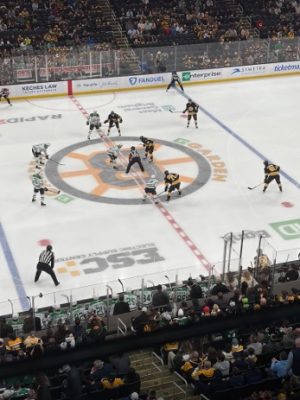
Bruins action on the ice against the Dallas Stars at the TD Garden on March 31 Photo by Brennan Ryan
March 31marked the Boston Bruins’ 28th home win of the 2025-2026 season, defeating the Dallas Stars 6-3 at TD Garden.
Ending the month of March with a record of 10-3-3, the Bruins head into April on a four game win streak and maintaining the first wild card spot in the Eastern conference.
The B’s put up two goals in the first period and limited their opponents to five shots.
In the second period, the Stars fought back to tie the game with two even strength goals.
Entering the third period tied, the black and gold were hungry for the win against the third-best team in the league.13 seconds into the third period, Bruin’s forward Elias Lindholm scored a power play goal to uplift the team.They went on to score three more goals in the third, securing the win.
Tuesday night’s game was also focused on celebrating Women In Sports Night, highlighting all female athletes, coaching staff, broadcasters, and fans. Some players from the PWHL’s Boston Fleet were in attendance, with star defender Megan Keller showing off her gold medal earned at this year’s winter olympics.When shown on the jumbotron, the athletes were met with cheers and applause bouncing off of the TD Garden walls.
With “Back in Black” by ACDC played over the loudspeakers, and yellow and white laser beams floating around the arena, the Bruins took the ice, with fans banging on the class and cheering.“The fans definitely didn’t come to play today,” said a Bruins fan who wished to remain anonymous.Even with a handful of green jerseys in the crowd, and those same fans chanting “STARS” during the national anthem, the black and gold were ready to secure the two points.
The Bruins’ starting lineup was Nikita Zadorov and Andrew Peeke at defense, Morgan Geekie, Elias Lindholm and newest addition to the roster at the trade deadline – Lukas Reichel at forward, with Joonas Korpisalo in net. Dallas Stars’ starting line up was Nils Lundkvist and Thomas Harley at defense, Colin Blackwell, Adam Erne and Justin Hyrckowian at forward, with Jake Oettinger in net.
Marat Khustnutdinov got the Bruins going early, scoring a wrist shot at 9:58 in the first period, capitalizing off of a rebounded shot.
At 18:51, Viktor Arvidsson doubled the score on a wrist shot, sneaking in behind goaltender Oettinger for the tap-in just as the Bruins’ man advantage ended.This marked Arvidsson’s 22nd goal of the season, and it was a special one.In the stands, his eldest daughter was celebrating her fifth birthday.
“I thought the whole game had really good energy,” said Bruins’ fan Andrea Martin. “Getting to see all the excitement from the crowd was awesome.”
At the start of the second period, it was evident the Dallas Stars flipped a switch.At 4:49, Stars’ captain Jamie Benn scored a wrist shot on the team’s ninth shot of the game, cutting the lead in half, 2-1.
A little over 12 minutes later, the Stars tied the game.At 16:53, forward Matt Duchene beat Korpisalo, sending the puck up over his right shoulder for his 15th goal of the season.With just under two minutes remaining in the second period, Benn lifted the puck up and over the glass with an immediate delay-of-game penalty called. The Bruins went on the man advantage ending in the second, and carried 18 seconds of the man-advantage into the third.
With five seconds left in the power play and 13 seconds into the third period, E. Lindholm’s wrist shot gave the Bruins the lead once more.He was fed a leading pass from David Pastrnak and shot the puck above Oettinger’s right shoulder.At 5:51, Bruins’ defensemen Henri Jokiharju took a slapshot from the center of the attacking zone and scored his first ever goal as a Bruin in his 39th appearance for the team.
“It was a welcomed surprise seeing Jokiharju score, it was exciting to see someone’s accomplishments firsthand,” said anonymous.
With less than five minutes to go, the Dallas Stars attempted to pull their goalie for an extra attacker, but it immediately backfired.Arvidsson quickly saw the empty net and fired from his defensive zone, picking up his second goal of the night.With a score of 5-2 Bruins, the Stars capitalized on a power play.Wyatt Johnston tightened the game at 19:02 with his 41st goal of the season, but it was too late for the Stars.
With Oettinger out of the net, the puck was dealt to Arvidsson’s stick once more. At 19:47, he shot home his 24th goal of the season, and completed his fifth career hat trick.
Hats came flying down to the ice and the crowd was louder than ever. “Nine goals and a hat trick – I’ll take that over any fights,” said Martin. “And Drake Maye was there.”
That’s right.
As the cameramen were perusing the crowd, a young man was shown sporting an “I heart Drake Maye” shirt.The camera remained on him for a suspicious amount of time, until it panned to Patriots quarterback Drake Maye and his wife Ann Michael Maye also at the game in support of the black and gold.The crowd went wild – fans were jumping out of their seats.
Fans are on the edge of their seats with eyes locked on the game ahead.Players giving it their all, throwing themselves at every play with their love for the game on their sleeves.A final shot – exciting the crowd as it hits the back of the net.The winning team clears the bench, rushing to celebrate with teammates and a smiling coach, together.The losing team huddling and leaving together.Fans of the winning team cheering, throwing popcorn, dancing, laughing and more.Fans of the losing team collectively upset, leaving together.
No matter the outcome of a game, one thing is sure – players and fans have created a connection through the emotions and experience.Across the globe, sports are more than a competitive activity – sports create a vast community through shared experiences and emotions between those in the stands and those on the field, court, ice, etc.
“Sports create common goals and strong emotions that connect people on a deep level,” said student-athlete Kaelie McCracken. When it comes to playing on a team,the abundant amount of time spent with teammates forms bonds and friendships.Players experience the same wins and losses, grow together, and share emotional times.This builds community by empowering the concept of teamwork.Struggles are inevitable, but having a strong group of teammates by your side makes the struggle worth it.
Teammates and coaches see all sides of each other – the good, the bad and the unintentional.The display of strength teams use to uplift each other feeds into the stands, resonating with their fans. The community grows from the players to fans, friends, families and schools at any level, all the way to professional sports.
“Fans, players, and communities all share emotions tied to the game, which creates connection,” said student Allie Simons, a club hockey player and a Boston sports fan.
In the stands, fan bases are the core of any sports team.Showing up, dressing in team gear and colors, bringing signs, engaging with like-minded fans. Starting chants to support the home team, or having guts and starting a chant for the away team is one of the ways fans and players create a growing community.Having fun with “strangers” with the same goal, doing the same activity.Fans are families, friends, coworkers –people from all walks of life.
Athletes also enjoy other sports and are fans of other athletes. Why are we always so excited to see professional athletes enjoying a different sporting event? It is because fans can connect with athletes, and the athletes are connecting with the fans.
Sports are all one large support system.
When watching and cheering on a team, fans know they are not alone.Sports connect people on such a deep level where people throw parties and often treat championship games with the same importance as holidays like Thanksgiving and Christmas.
Regarding why fans support teams, Simons said, “it gives them a sense of belonging and identity, and fans feel loyalty and pride in representing something bigger than themselves.” Being a sports fan is beyond the wins and the losses; it is about feeling involved, included and seen in personal enjoyment.Sharing love for a team – no matter the level – is something so intimate that strengthens a vast, diverse community.
When fans show their support, it feeds on to the players.When fans know what they do – cheering, attending games – is helping their team succeed, they cannot help but feel successful themselves.
When supporting a team, McCracken said, “it’s rarely about the sport itself, it’s about what the team represents.”Many sports teams are ambassadors and participate in charitable work.Athletes’ stories – even the sad ones – are brought to light to display their humanity and create a stronger connection with fans.Fan bases care so deeply for athletes they may view as heroes.
Sports fans carry a team’s win or loss with them to work the next day, just as the players do heading into their next practice.
Between players and fans, their energies feed off of one another.When a team is thriving, their fans are thriving, filling the crowd with cheers.Student Sadie Yapor said, “there is a joy of seeing your team win and having the feeling you were a part of it all.”
Four years later, the Winter Olympics are back – the games held in Milano and Cortina, Italy, began on February 6th and all sporting events will be completed and closed out on the 22nd, 2026.From alpine skiing to speed skating, there are 116 medal events over the course of these two weeks, varying across eight different sports and 16 disciplines, and around 2,800 athletes will be competing.
Team USA has brought in 235 athletes – the most in winter Olympic history – and are competing in all events.“Having so many athletes gives team USA a lot of depth, and it gives them really good chances to win some medals,” said student-athlete Izzy Tanguay.
After the two weeks of events, there have been many triumphs and upsets across the board. Team USA’s Alysa Liu won gold in women’s single skating at just 20 years old after coming out of her retirement from 2022. Team USA took gold in two events for women’s alpine skiing and bronze in the combined team event.USA’s women’s hockey team won gold against Canada, after taking silver in 2022; and the men are set to play the gold medal match against Canada – a rematch of the Four Nations tournament final last February.
“It’s inspiring how many athletes push themselves through severe pains and injuries,” said Tanguay.Unfortunately, four-time Olympian Lindsey Vonn was seriously injured after she crashed at her first event in alpine skiing 11 seconds in.On the course, she was medflighted and rushed to the hospital where she underwent multiple surgeries to repair her broken leg.
Team USA’s Ilia Malinin placed eighth in the men’s figure skating single event.After his performance, he opened up during a candid interview expressing he was unaware of the true stress and intensity the Olympic games bring.From olympics.com, Malinin told interviewers, “(the olympics or medals) doesn’t change who you are as a person or even as an athlete.”He went into the event wanting to make history with his quad axel jump, but he skated off with grounding experiences being only 21 years of age.
In the sport curling, team USA’s women were beaten by Switzerland in the semi-final, earning silver.Curling has exploded in a form of popularity at this year’s Olympics, where many are confused and admit they do not fully understand the event.“The only thing I know about this year’s Olympics is the sport curling, and I don’t know why it is even a sport,” said student Milina Quizhpi-Lema.
With the winter games bringing 93 countries together to compete, the question arises: Does it unite people across the globe, or does it divide all biased in nationalism?The Olympics are a great outlet for countries to gain recognition and prove their space in the games.It can highlight countries and athletes that may be overlooked, or it can create intense division between rivaling countries.“The Olympics are especially important today as the world has felt very divided in recent years,” said student Ashlyn Sullivan.When athletes compete in their events, there are always cheers and applause for all – no matter the size of a country, or number of athletes representing the country – they all own their space to display skills and talent, while also using their platform for good. The Olympics gives a space for all to voice what they represent because in today’s world, it is more than just sports.
With the games being held across Italy, there are time-zone differences.Italy has a six-hour difference from Eastern Standard Time (EST),which makes live viewing a challenge for many Americans. As an alternative, many find themselves watching primetime showings at 8:00pm EST, or through social media.Student Isla Donnelly said, “I see a lot of clips on TikTok, it quickly grabs my attention and attracts more viewers for the Olympics.” Across the globe, there has been an extreme upsurge in daily viewers of the winter games. According to NBC, the streaming service is averaging around 23 million viewers for the 2026 games.Compared to four years ago, this is an increase of viewers by about 86%.
As of February 20th, the games are continuing in Italy.Team USA is currently holding 29 medals; but the true meaning of the Olympics is more than decoration.The stories of hard work, resilience, bravery and representation are what shines through.“Sports are played all over the world, and the Olympics helps to unify people through the games,” said Sullivan.At the end of the day, a spot on the podium matters less than the sportsmanship and unity the Olympic games create – whether it be summer or winter.
When these games are nearing the end, the United States and the rest of the world focus their attention to celebrate the paralympians participating in the 2026 Winter Paralympics held in Milano Cortina, Italy from March 6 to March 15 – cheering for the sports, the athletes, the coaching and the fans that bring people together.
In May 2025, the Secretary of Treasury was ordered to stop the production of new pennies.The production of pennies has been ordered to stop in the beginning of 2026, which is getting closer as the days go by.As the discontinuation of pennies is nearing, there are raising concerns and potential benefits.
It costs four cents to produce a singular penny.It costs more to make a penny than how much it’s worth.When talking about the costs to make pennies, student Ellie Dimopoulous said, “it seems wasteful.”With that being said, to create a nickel, it costs the U.S. Mint roughly 14 cents.On the other hand, an article from NBC10 explained how in order to make dimes, it costs the U.S. Mint almost six cents, and the quarter costs nearly 15 cents.Eliminating the production of pennies has been reported to result in saving $56 million a year.
“I think we’re still going to need pennies,” said student Grace Barber. “And making less pennies isn’t going to help.”
It will take time for the penny to completely disappear from wallets and cash registers, but the history will remain.The United States Mint, where all coins are produced and circulated, began the official production of pennies in 1793. The first penny was engraved with a woman with flowing hair, and the government explained this is “symbolizing liberty”.From then on, pennies have evolved to the copper face of Lincoln that we all know.
Some citizens fear that the stopped production of the penny is getting rid of history during these changing times. “We’re not eliminating it (the penny) because of tradition,” said Dimopoulous.With the government’s reason for eliminating pennies, there is nothing about trying to destroy parts of history; the removal of the penny is more of an economical tactic.
“Pennies are so unnecessary, they take up more space in our wallets than needed,” said student Milina Quizhpi-Lema.
What’s going to happen to prices ending in 99 cents? Even though most transactions use cards nowadays, there are still plenty of people who use cash.“I do use my change a lot,” said student Celia Vallone.With the removal of the penny, there is an inkling that companies will be guided towards rounding their prices to the nearest dime and nickel.Another name for this is “rounding tax”.From an article from the Federal Reserve Bank of Richmond, the potential for rounding when it comes to cash transactions is as follows: if a price ends in one, two, seven or six cents, the price will be rounded down.If the price ends in three, four, eight or nine cents, the price will round up. Even with these supposed rules, most businesses will most likely lean towards rounding up their prices.Student Ashlyn Sullivan said, “Even though it would only be a few cents, it adds up overtime.”
“The elimination will definitely lead to something bigger,” said student Jenna Santo. “This is just the small step.”
With the production of the penny ending at the start of 2026, there is much more that will come with it.Vallone said, “people mostly use credit/debit cards and Apple pay a lot more now.” Although this is true, pennies are a part of everyday life.At registers, there are ‘take a penny, leave a penny’ trays. Cashiers may ask if you want to round up one cent for donations and charities.Pennies are thrown into wishing wells and fountains; it’s more than just money.
On a positive note, discontinuing the production of pennies will save the government $56 million a year, but where will it go? Talking about the saved money, Sullivan said, “(the money) would probably just go right into the government’s pockets. So no matter what, people will lose.”
It will take time to completely get rid of using pennies in everyday transactions, but it leaves room for questions.Is this a change for the better?